


|




Market risk disclosure
|
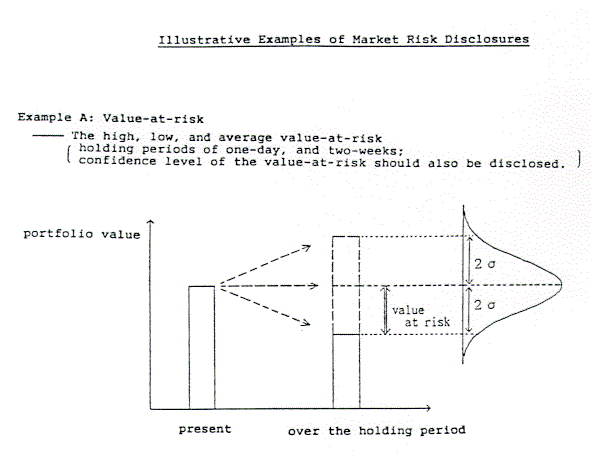
As noted in the text, no consensus exists on a single best method of measuring market risk exposures. However, most market risk assessment systems share a number o common features (see paragraph 3.5). Many of these features are present in value-at-risk calculations, a method that is increasingly widely used. Without prejudice to other methods, the following paragraphs briefly describe this method and provides an example of how it might be used to disclose the market risk profile of a portfolio.
Value-at-risk is a concept derived from statistical estimates of the losses or gains a portfolio could experience, due to changes in underlying prices, over a given holding period, for given confidence intervals 4. The confidence interval is an estimate of the changes in portfolio value that are likely to occur some proportion of the time -though for disclosure purposes, likely declines in portfolio value might be most relevant. For example, over a one-week time horizon, the portfolio could experience a larger loss (than the reported value-at-risk) with a likelihood of 1% (i.e. in one week out of a hundred).5 The interpretation of a value-at-risk figure requires knowledge of the confidence interval and the holding period used in the estimation. For example, the value-at-risk with an associated likelihood of 1% is higher than the value-at-risk with a 5% confidence level. In addition, the value-at-risk for a one-day holding period is smaller than the value-at-risk for a holding period of one week. Hence, a value-at-risk report should always be accompanied by the associated confidence level and the holding period. 6 Value-at-risk is an effective tool for describing and communicating risk because it assesses different risks in terms of a common metric -- losses relative to a standard unit of likelihood. For this reason, it can be used to compare and aggregate risks across instrument types, trading units, and markets. In addition, value-at-risk lends itself readily to a comparison of trading outcomes and risks taken to attain those outcomes, because it is articulated in terms of the size of potential losses. Example A: Using value-at-risk to disclose risk profiles. For the relevant portfolio(s), the firm could disclose:
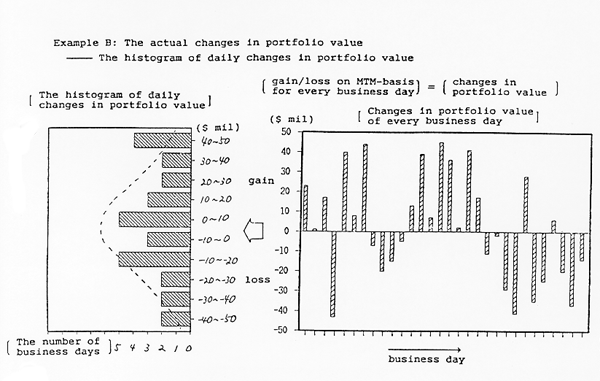
Along with the value-at-risk figures, the associated confidence level of the value-at-risk should also be disclosed -- interpreting a value-at-risk figure is not possible without the associated confidence level. The disclosure in this example would convey, information about the riskiness of the firm's portfolio during the reporting period, and in the case of firms whose portfolios change over the reporting period, the disclosures would indicate the degree to which the firms' risk profiles change. The use of holding periods longer than one-day in this example provide an indication of the portfolio's exposure to market liquidity risk -- the risk that positions cannot be closed out when desired -- as well as its exposure to gamma or curvature risk arising from options or option-like elements. To properly measure curvature risk, however, the changes in portfolio value should be calculated explicitly for the two-week holding period. Simply multiplying the one-day value-at-risk by the square root of ten (the number of business days in a two-week period) would obscure the gamma or curvature risk in the portfolio. Value-at-risk is one way of measuring risk, and, even though it is becoming more widely used, other approaches are also used by market participants. For firms that do not use value-at-risk, a measure of volatility of actual outcomes could also reveal riskiness. The next example presents one alternative measure of risk. Example B: Using realised outcomes to disclose riskiness. For the relevant portfolio(s), the firm could disclose:
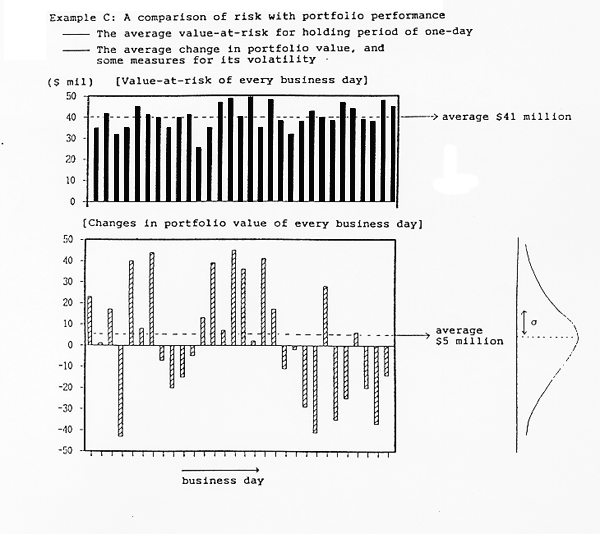
Other measures of risks that are used by market participants include (for interest rate risk) gap analysis and duration. While these measures do not lend themselves to a comparison of risks and performance as directly as does value-at-risk, such alternative measures of risk could be used in a discussion of risk profiles and risk management outcomes. Disclosure of risk profiles alone, as in the above examples, however, would not adequately meet the principles recommended in this paper. Disclosures should also allow an assessment of the firm's capacity to manage its exposures to market risks. The next example depicts one way of conveying information about risks and performance. Example C: A simple disclosure of risk and performance. For the relevant portfolio(s), the firm could disclose:
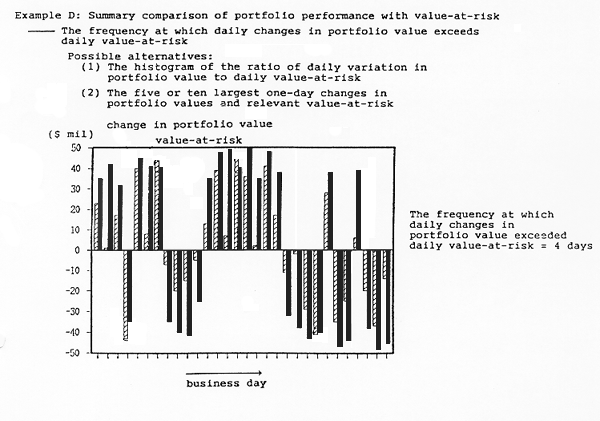
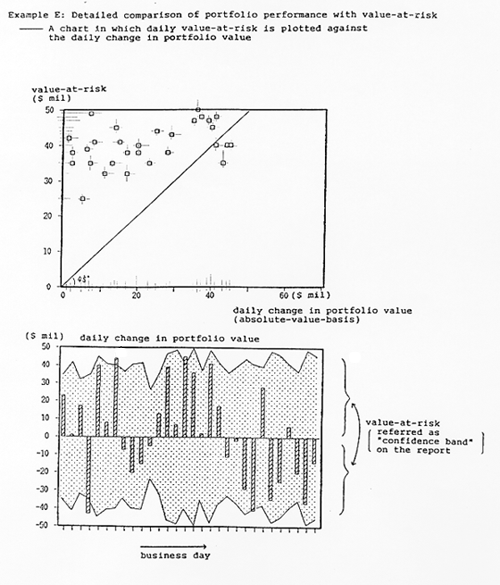
c.2 the average change in portfolio market value, and some measure of its volatility. The volatility of changes in portfolio value could be depicted in a variety of ways, such as one of the following: the standard deviation of daily changes in portfolio value; the largest declines and largest increases in portfolio value corresponding to, for instance, the lower 5% and the upper 9S% of the distribution; or, the histogram of daily changes in portfolio value. The unpredictability of market prices and the unstable nature of correlations between different prices implies that trading outcomes (and to a lesser degree, hedging results) will be variable. For this reason, the disclosure of only average outcomes is not sufficient. Some measure of extreme outcomes, or the tails of the frequency distribution of changes in portfolio value, are required for an assessment of the firm's ability to manage its risk within a range determined by its appetite for risk. Examples D and E, depict possible approaches to this problem, that are based on a comparison of the tails of the frequency distribution of realised outcomes and ex-ante value-at-risk. Over time, successful risk management would tend to keep the frequency of large declines in portfolio value below a level consistent with a firm's appetite for risk. As a description of a portfolio's riskiness, value-at-risk could provide information about a firms appetite for risk in the management of that portfolio. One measure of risk management performance, therefore, is the comparison of the confidence level of the value-at-risk with the frequency of the declines in portfolio value that exceed value-at-risk superior risk management would tend to keep the frequency of large losses below the frequency associated with the confidence level of the value-at-risk. Such comparison would require information about the tails of the frequency distribution of changes in portfolio value. Disclosures therefore should allow outsiders .o evaluate the performance of risk management by disclosing information about declines in portfolio values in sufficient detail. A disclosure of the single largest decline or the single largest gain in portfolio value would not allow a meaningful assessment of risk management, because value-at-risk is a statistical confidence interval-changes in portfolio value will fall outside this interval some proportion of the time. The assessment of risk management requires information relating to a sufficiently large number of trading days in order to discover whether the frequency of large decreases in portfolio value is significantly larger than the confidence level of the value-at-risk. 7 Example D: Summary comparison of portfolio performance with value-at-risk. For the relevant portfolio(s), the firm could disclose:
Such summary data could be presented in a variety of ways. A minimal approach would be to disclose the frequency with which daily changes in portfolio value exceed value-at-risk. More informative alternatives would be to disclose the histogram (frequency distribution) of the ratio of daily variation in portfolio value to daily value-at-risk, or the five or ten largest one-day declines in portfolio values together with the (one-day prior) estimate of the one-day value-at-risk for the days on which- these declines occurred. 8 Along with the value-at-risk data, the associated confidence level of the value-at-risk should also be disclosed. Example E: Detailed comparison of portfolio performance with value-at-risk. For the relevant portfolio(s), the firm could disclose one of the following alternative depictions of the relationship between daily value-at-risk and daily changes in portfolio value:
Trading units with significant intraday positions relative to end-of-day or overnight positions should include intraday activity in disclosures of portfolio risks. For example, if value-at-risk is measured in real time, then the peak intraday value-at-risk could be used; alternatively, the intraday value-at-risk could be based on intraday trading limits. A risk measure such as value-at-risk can only be a measure of the risk profile of the current portfolio. To the extent that the portfolio changes, the risk measure of the old portfolio might not reflect the riskiness of the new portfolio. For this reason, interpretation of measures of risk must be performed with care. As mentioned above, one way of addressing the issue of intraday trading is to include in daily value-at-risk an estimate of the risks due to intraday trading. The next example gives another way of addressing this issue. Example F: Disclosure of portfolio performance using a benchmark portfolio. The disclosures of the type described in the preceding examples could be supplemented with measures of performance based on:
f.2 the actual change in portfolio value (the previous day's portfolio valued at yesterday's closing prices subtracted from today's end-of-day portfolio value at today's closing prices). Such measures would allow comparison of trading and risk management performance, by comparing actual portfolio performance with the benchmark performance of the "unmanaged" beginning-of-day portfolio. 9 Disclosure of interpretative information. The quantitative disclosures in the preceding examples should be supplemented by information necessary to interpret the quantitative data. For example, as already mentioned, the parameters of the value-at-risk figures should be disclosed. In addition, the relationship of the portfolio (about which the quantitative disclosures are made) to the rest of the firm should be made clear. Likewise, in the disclosure of risk and performance, information should be provided about the treatment of revenues from market making (customer spreads) and gains and lasses from position taking.
Footnotes:
4. The holding period refers to the time interval over which changes in value of a given portfolio is assessed. Holding the portfolio constant, a longer holding period entails higher risks, because a large price move is more likely over a longer interval of time.
5. Value-at-risk incorporates two important components of risk: (1) he sensitivity of a portfolio to changes in underlying prices (how well the portfolio is hedged), and (2) the volatility of underlying prices (the likelihood of large price changes).
6. The following examples show how value-at-risk estimates calculated using different confidence levels and holding periods are related. The examples assume a given portfolio whose composition remains fixed over time:
7. Over a reporting period of 13 weeks, the five to ten largest instances would be sufficient, depending on the confidence level, but over a different reporting interval, a different number or instances would be appropriate. Moreover, a single time period as small as 13 weeks is not sufficiently long to allow reliable conclusions. Hence, the assessments of the type described here, would require interpretation of disclosures over a long period of time. Such assessments, however, require that a sufficiently large data set be assembled-disclosing the single largest gain or decline in a reporting period would not be sufficient.
8. The actual dates on which these events occurred need not be disclosed. In addition to the decline in portfolio values, the five or ten largest one-day increases in value and their associated one-day value-at-risk could also be disclosed.
9. The reliability of the models used to estimate value-at-risk could also be revealed by comparing prior estimates of value-at-risk with the benchmark change in (f.1).
|
Contact us *
Risk Library *
Documents by Author *
Committees at the Bank for International Settlement (BIS) *
Public Disclosure of Market and Credit Risks by Financial Intermediaries *
Appendix
